““His manners and appearance did not calculate to please;
His coat was torn and seedy, he was baggy at the knees;
One ear was somewhat missing, no need to tell you why,
And he scowled upon a hostile world from one forbidding eye”
Growltiger’s Last Stand
If your only encounter with Andrew Lloyd Webber’s Cats is the Tom Hooper film of 2019, you could be forgiven for a certain bewilderment on learning that the stage version which preceded it by some forty years was once the longest-running musical on both the West End and Broadway. It ran in the West End for twenty-one years and played uninterrupted on Broadway for eighteen. More than that, it is widely credited as the show that lit the fuse on the whole mega-musical genre, the phenomenon that went on to sweep across Broadway, the West End and, in time, most of the world.
I have a confession to make. In the thirty-odd years I have been thoroughly bewitched by theatre, I have never once seen Cats. I have heard about it, of course. I have walked past the posters more times than I can count. I have heard “Memory,” the runaway standout and surely the most iconic song the show has to offer, performed on more occasions than I could ever hope to tally. I even sat down to watch the film, and lasted barely ten minutes before I wanted to scrub myself clean with something abrasive. For whatever reason, it had simply never appealed.
So it was with a peculiar mixture of dread and genuine excitement, the latter born of the faint hope that I might be about to see something transformative, that I made my way through Regent’s Park to the Open Air Theatre and this latest interpretation of the mega-musical that started it all.
The plot, such as it is, can be told in a single breath. Once a year the Jellicle cats gather by night for the Jellicle Ball, where their patriarch Old Deuteronomy will choose one among them to ascend to the Heaviside Layer and be reborn into a new life. That is more or less the whole of it. What sits between is a parade of feline characters, each stepping forward to introduce itself before melting back into the ensemble.
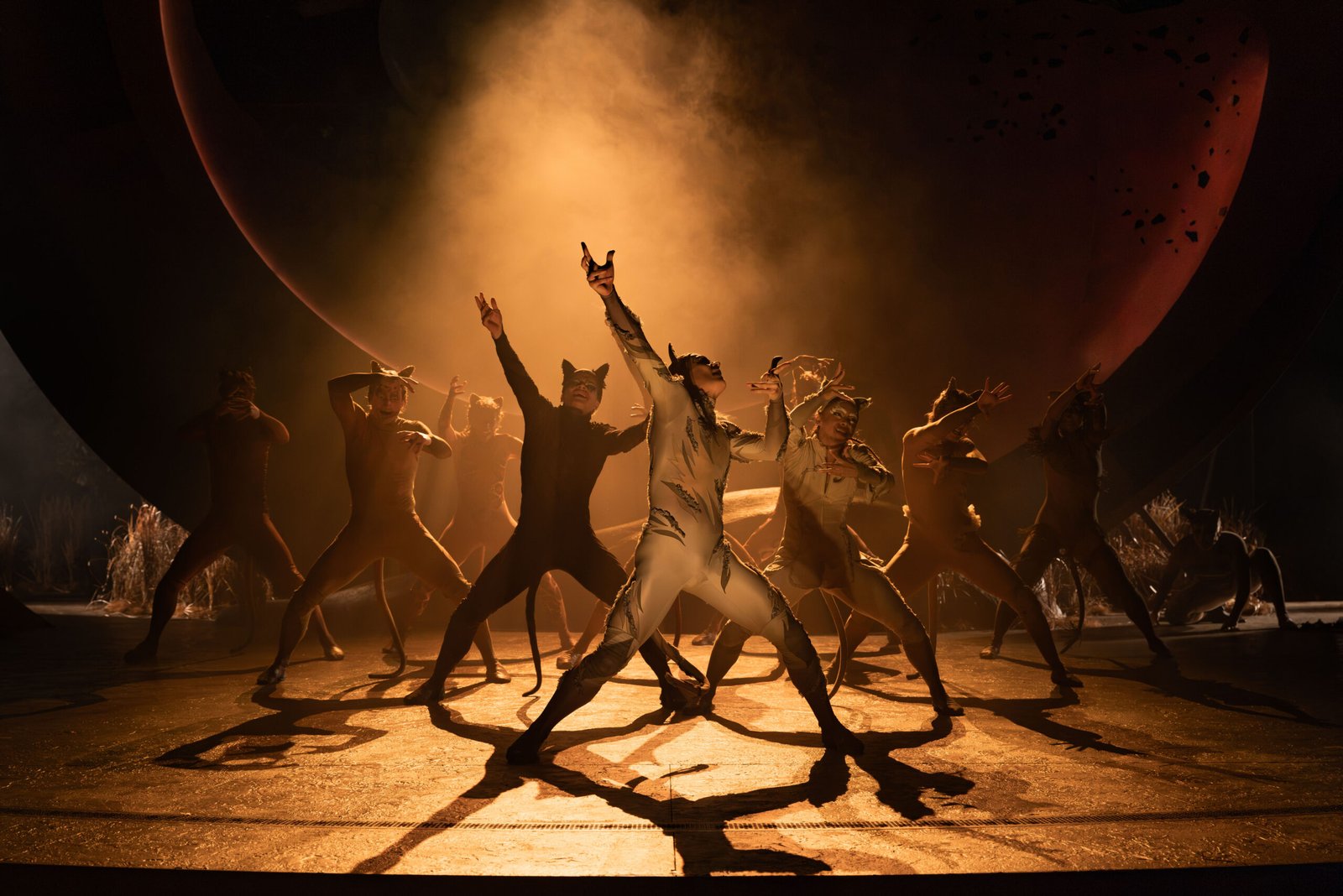
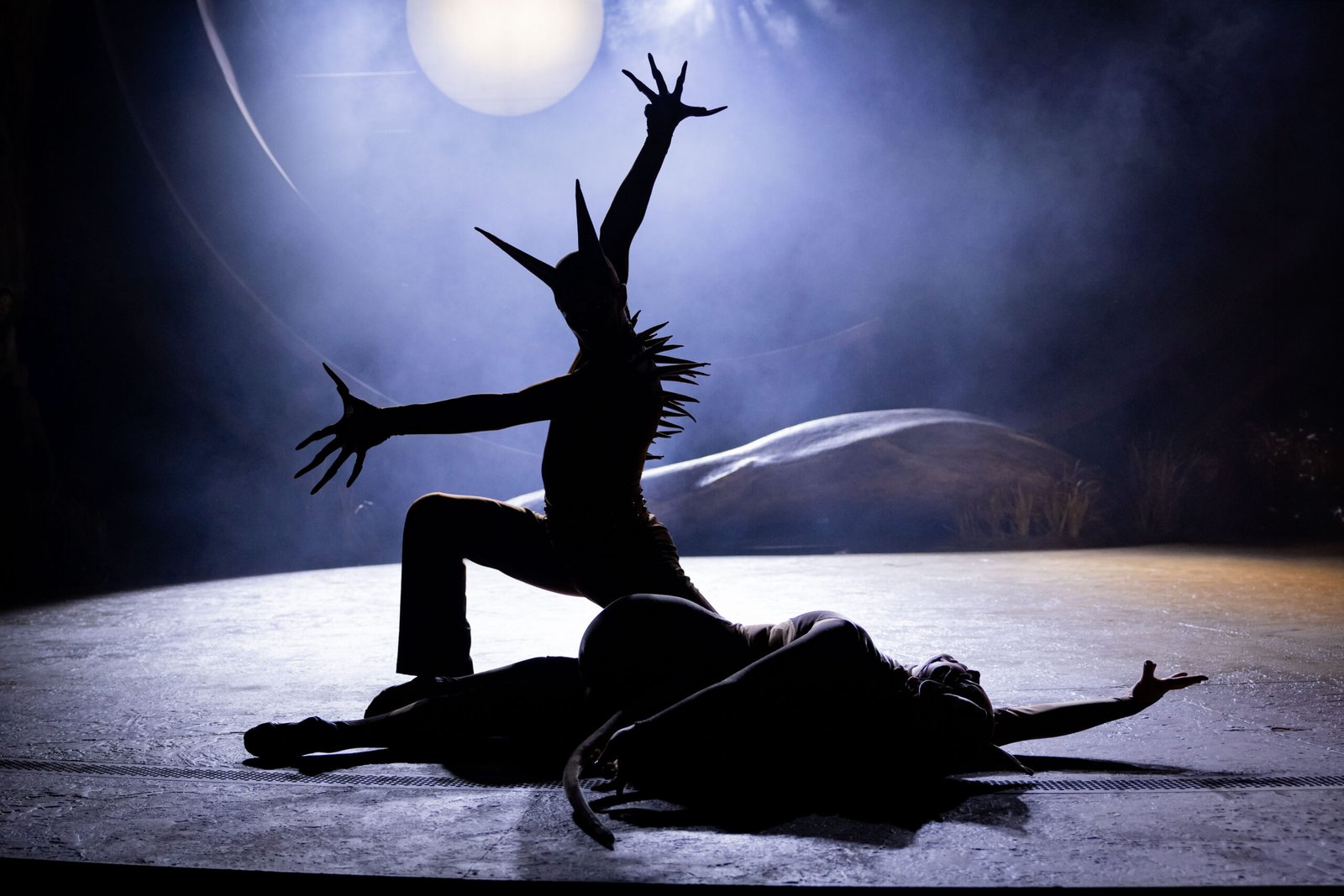
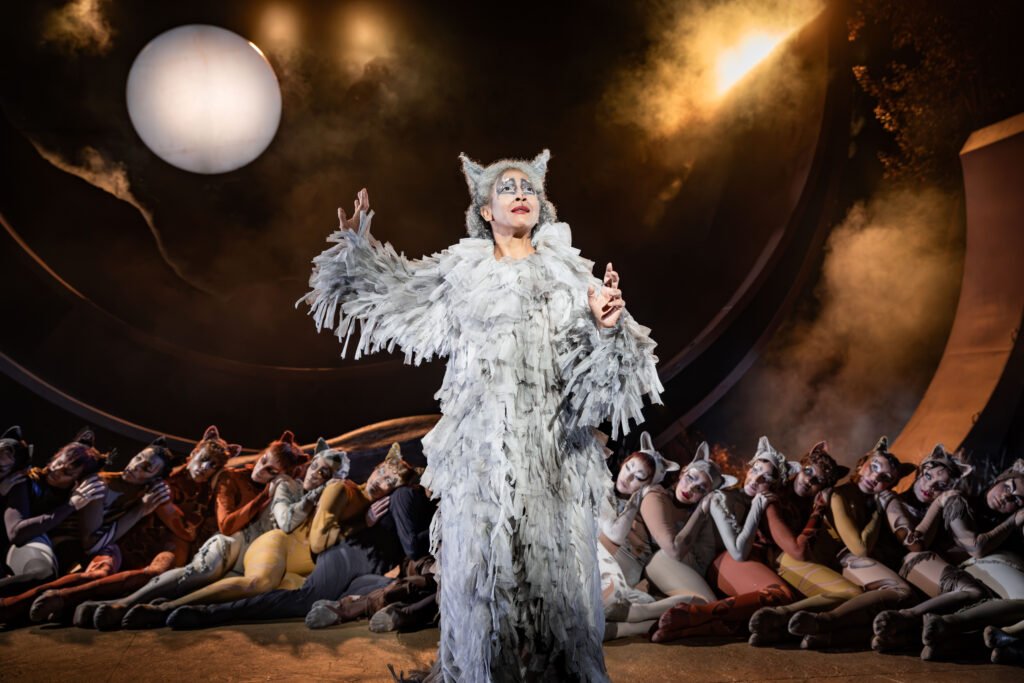
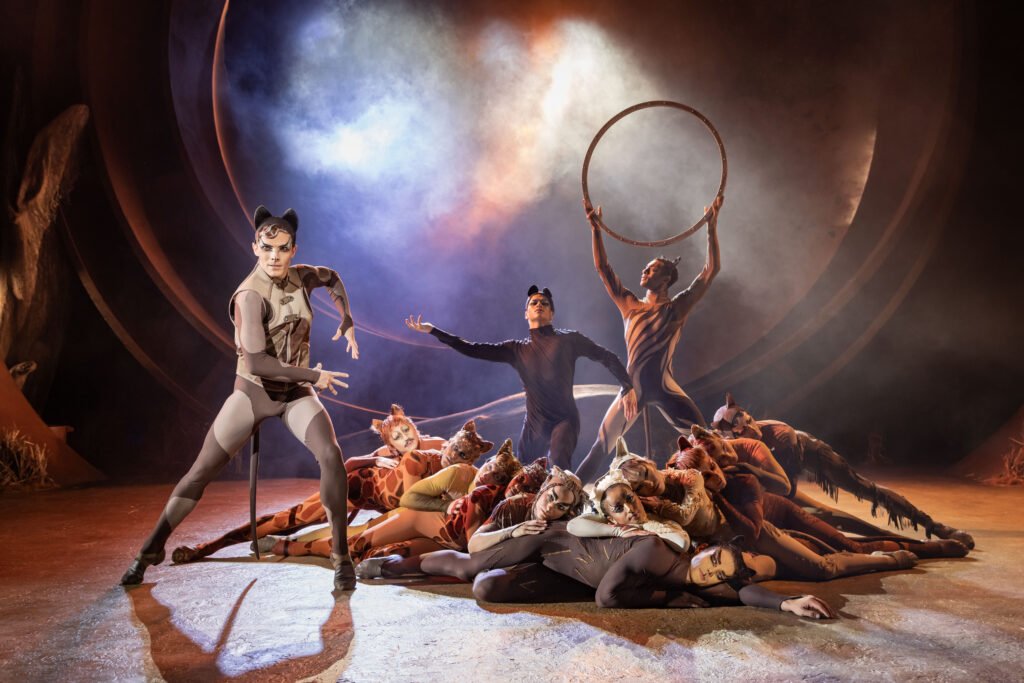
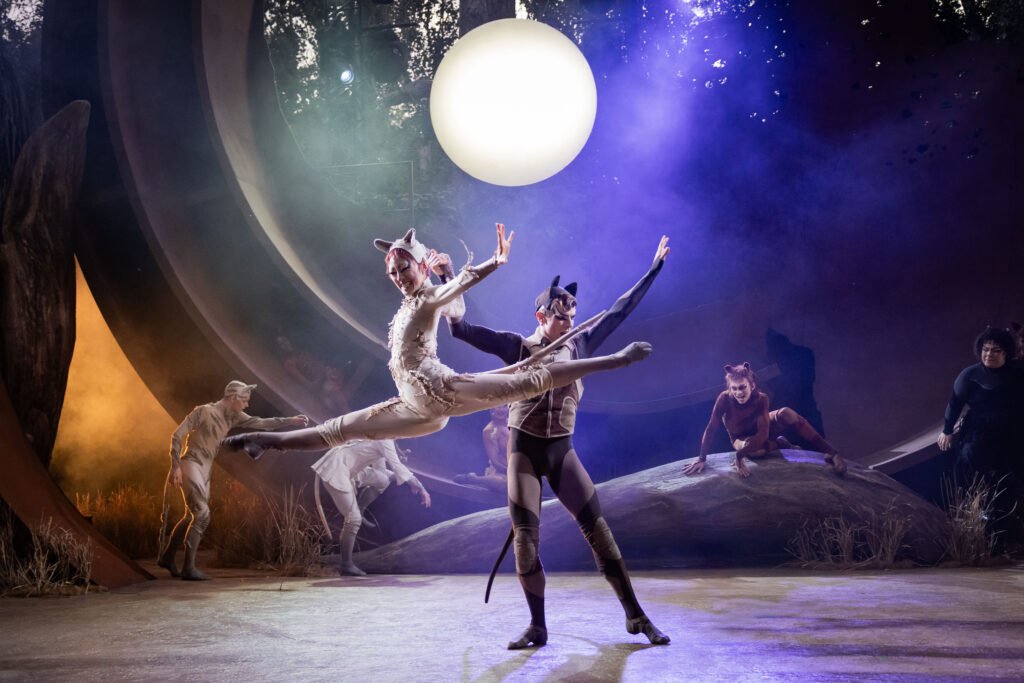
Sami Fendel’s design, who is also responsible for the wigs and costumes, is a simple affair. A circular stage, and set to the back of it a huge wrought, rusting iron ring within which hangs a disc of moonlight. That is about the size of it. It is striking enough in its way, though it gives little hint that we are about to be plunged into the world of London’s alley cats.
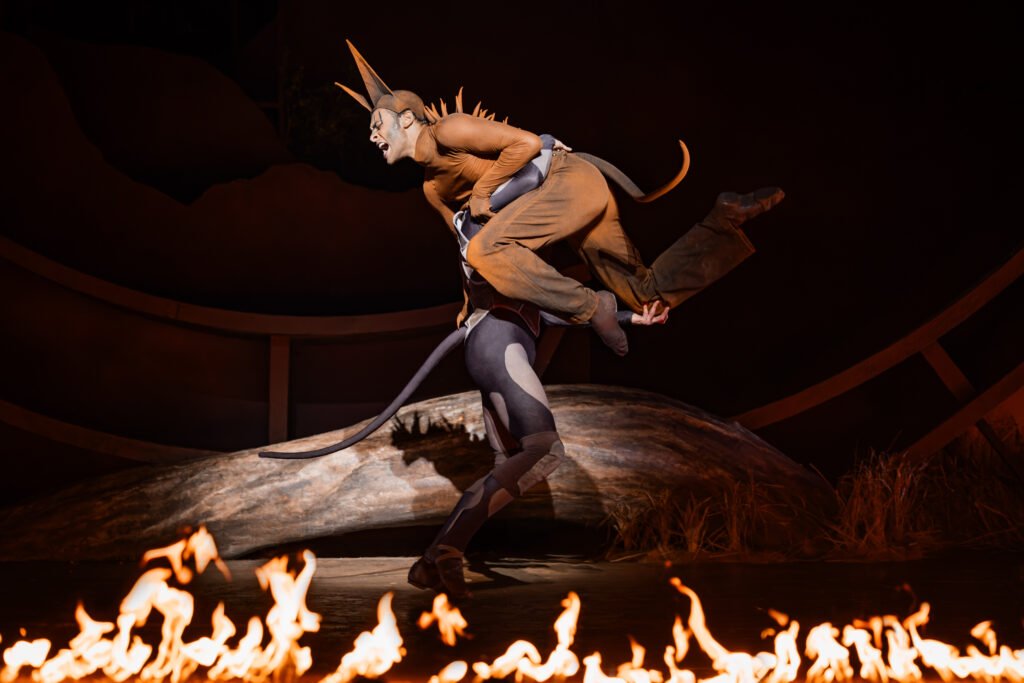
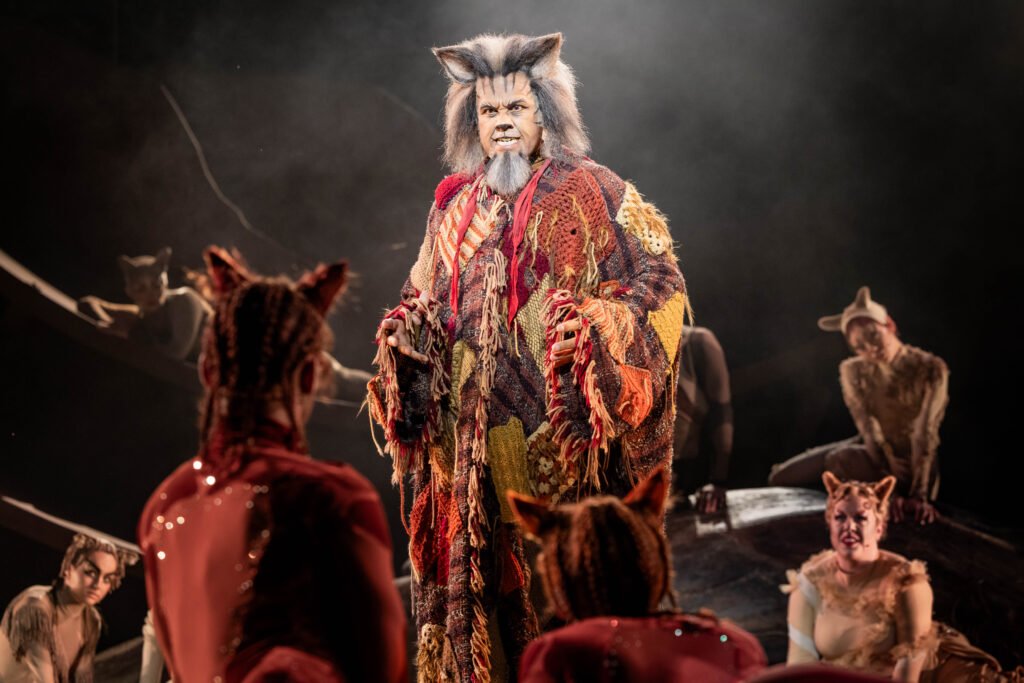
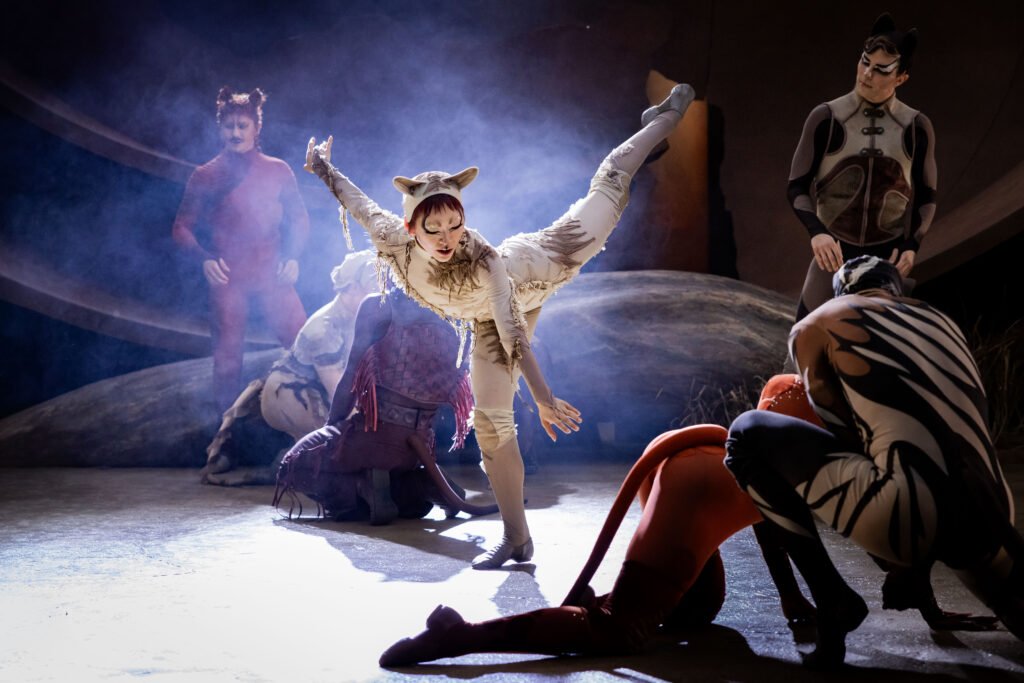
As the cats come cascading onto the stage, spilling in from the back of the auditorium and the sides of the playing area, the costumes sit squarely in the tradition of the original: black, white and beige leotards and leggings, dotted here and there with little tufts of fur and markings to suggest something skin-like and feline. Cat-like wigs, pointed ears, tails, and that really is about it.
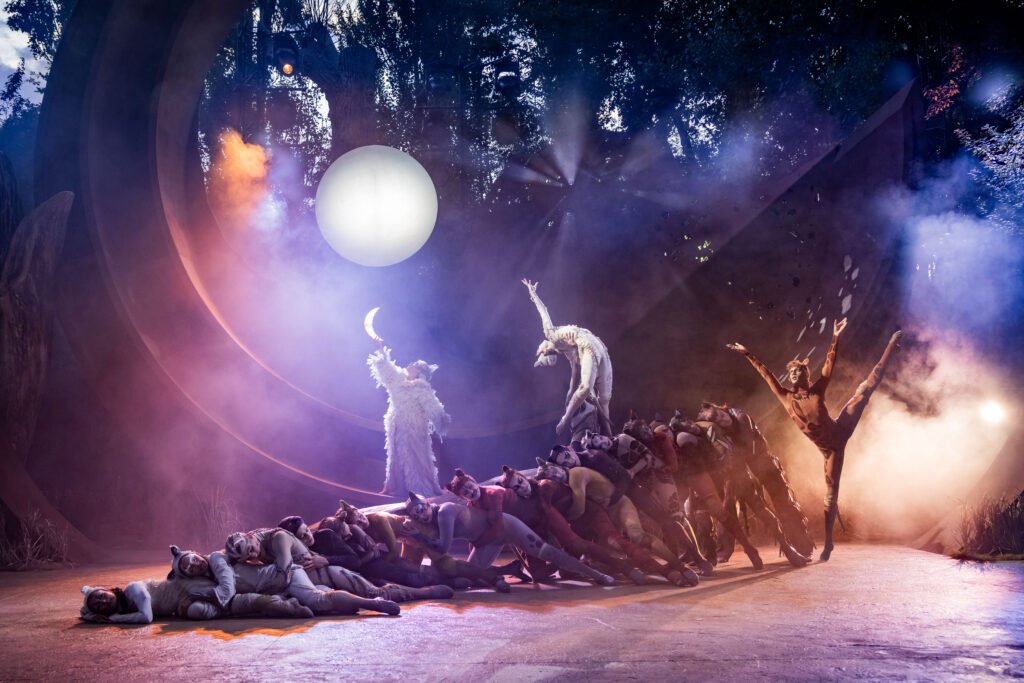
In an age of hyper-realism it lands, at first, as jarring and very nearly amateurish. Do not be fooled. The performers have honed their movement to the very last degree, and Drew McOnie’s direction and choreography ensure that they inhabit the feline entirely. The choreography is, for the most part, controlled and unshowy, and it has to be, because most of these dancers are singing throughout. They are forever balancing the demands of movement against the need to deliver the vocal, and they manage it beautifully.
There are moments, naturally, where the dance is allowed to take over and the choreography comes into its own alongside Lloyd Webber’s score. And after a few minutes of adjustment, watching what are so plainly humans in leotards sliding and flailing about like cats, when it is all one can do to bite one’s lip and stifle a laugh, something rather magical happens. By the time the overture has run its course, that jarring quality simply stops registering, and what is left is the thing that only theatre can do. Theatre, done well, does not pretend to be what it is not. It is not chasing realism; it is asking you to believe, and it needs you, the audience member, to meet it halfway. Surrender the urge to see the jaded, the dated and the amateurish in front of you, and you are pulled clean into their world. Once that journey begins, there is no arresting the tumble, and you find yourself simply lapping up all that unfolds.
Lloyd Webber’s music here is, to my surprise, rather inspired. The overture and the connective passages between the numbers are dissonant and jarring, and I confess I was never entirely sure what they were reaching for. But if one thing stands above all else, it is that the man knows melody. Some of the songs open a little unsteadily, not quite certain of themselves, and then within a bar or two a hook arrives, and more often than not these are joyous, crowd-pleasing things that leave you tapping a foot or nodding along in spite of yourself.
The story, drawn from T.S. Eliot’s poems, is frankly an absolute nonsense. The narrative thread strung between these verses, in essence an excuse for each performer to turn a party trick or claim a moment in the spotlight, is the slimmest of devices, and yet it proves surprisingly engaging. As one cat after another appears, has its scene and vanishes again, the whole thing builds towards the question of which of them will be the one to ascend.
Cats came a few years after Jesus Christ Superstar, and it sits very much in that vein. Lloyd Webber had not yet found his love of the orchestral, had not yet given us Phantom, and so the music is rooted in early-seventies rock and, more surprisingly, a good deal of swing and big-band jazz. The juxtaposition works a treat. The jazz lends the humour, the rock draws out the more dramatic and menacing edges of these characters, and the two together are, at their best, mesmerising.
McOnie’s direction is a delight, and with the set kept so simple there is nothing to pull focus from where it belongs, on the performers, who deliver, to a cat, with absolute joy. It is one thing to watch a fine performance. It is another, and rarer, thing to watch one and sense that everyone on stage is having every bit as much fun giving it as you are having taking it in.
The evening’s high point is, inevitably, “Memory,” and so a good deal of weight falls on Grizabella, here in the hands of Taziva-Faye Katsande, who does not disappoint. As the song climbs to its spine-tingling crescendo, her voice and the orchestra both at full pelt, you are left in no doubt of the sheer majesty of the thing. It is very much an ensemble piece, but Matthew Caputo deserves a mention for a gloriously camp and funny Skimbleshanks, as does Gary Wilmot, who brings a real gravitas and a good deal of emotional subtlety to Gus, the ageing theatre cat.
I walked back through the park a convert, and not of the halfhearted sort. I had arrived braced for the dated and the daft, bracing myself, if I am honest, for an evening to be endured rather than enjoyed, and somewhere between the overture and the final ascent that scepticism was quietly, completely dismantled. There is a particular pleasure in being proved wrong about something you were certain of, and rarer still to be proved this wrong, this thoroughly, and to be so glad of it.
Because what this production understands, and what thirty years of posters and film trailers had never once conveyed to me, is that Cats was never asking to be believed in the way we now demand our theatre be believed. It asks only that you meet it in good faith, and it repays that faith many times over: in the swing and the menace of the music, in an ensemble giving every ounce of themselves with palpable joy, and in a “Memory” that, sung as Taziva-Faye Katsande sings it, earns every inch of its reputation.
I came to Regent’s Park to finally cross an old show off a very long list. I left having fallen, at this late and unlikely stage, rather in love with it. This strange old creature has plenty of life left in its nine, and I suspect I shall be back to spend a few of them.
When Cats Are Maddened By The Midnight Dance
Jellicle Songs For Jellicle Cats
The Naming Of Cats
The Invitation To The Jellicle Ball
The Old Gumbie Cat
The Rum Tum Tugger
Grizabella, The Glamour Cat
Bustopher Jones
Mungojerrie And Rumpleteazer Old Deuteronomy
The Awefull Battle Of The Pekes And Pollicles Together
With The Marching Songs Of
The Pollicle Dogs
The Jellicle Ball
Memory
Why Will The Summer Day Delay–When Will Time Flow Away
The Moments Of Happiness
Gus: The Theatre Cat
Growltiger’s Last Stand
Skimbleshanks
Macavity
Mr. Mistoffelees
The Journey To The Heaviside Layer
The Ad-dressing Of Cats
Book and Lyrics by TS Eliot
Music by Andrew Lloyd Webber
Directed and Choreographed by Drew McOnie
Starring:
Owen McHugh
Hannah Joseph
Patricia Zhou
Elliot Broadfoot
Matthew Caputo
Rachael Wooding
Shona Mairi Masson
Katie Dunsden
Dianté Lodge
Jaydon Vijn
Danny Nattrass
Briana Craig
Taela Yeomans-Brown
Nathan Rigg
Fin Adams
Carla Bertran
Grace Burrows
Josie Chambers-Sims
Gary Wilmot
Joshua-Samuel Freeman
Charlotte Riby
Regan Garcia
Aaron Jenkins
Jack Wilcox
Taziva-Faye Katsande
Andrew Parfitt
Jet Yau
Lucie-Mae Sumner
Melanie La Barrie
Millie O’Connell
Director: Drew McOnie
Associate Director: Ebony Molina
Choreographers: Drew McOnie, Ebony Molina, Josh Baker
Set Designer: Sami Fendall
Costume Designer: Sami Fendall, John Napier
Wigs, Hair Makeup Designers: Sami Fendall, Guy Common
Musical Supervisor : Alex Parker
Lighting Designer: Jessica Hung Han Yan
Sound Designer: Adam Fisher
Musical Director: Geraint Owen
Extended and Booking until 19th September 2026
Theatre:
Open Air Theatre
Inner Circle
Regents Park
London NW1 4NU
Box Office: 0333 400 3562
Tube: Baker Street
Reviewed by Sonny Waheed
at the Open Air Theatre, Regents Park on 7th August 2026