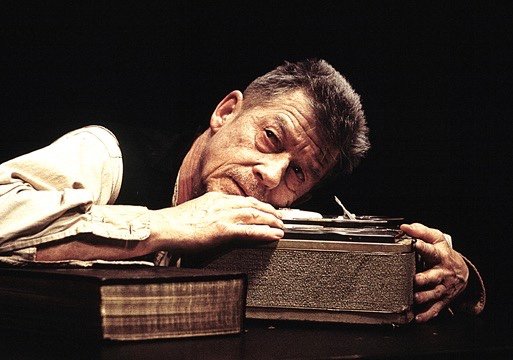
Krapp's Last Tape with John Hurt in 2000
“With all this darkness around me, I feel less alone.”
Krapp
I remember a few years ago taking my daughter to the Tate Gallery for her first experience of abstract art. At one point, we sat down and giggled. We weren’t sure whether this was great art or some enormous confidence trick, rather like The Emperor’s New Clothes, but we suspected that it might be. In any event, we did have a reaction. We interacted with the art. We related to the pictures rather than just glimpsing at them and walking on. In the same way my reaction to Krapp’s Last Tape, one of Beckett’s most famous plays, is that of an almost Beckett virgin (having seen only Waiting For Godot — twice) and, as such, it is divided.
On the one hand, I was mesmerised, transfixed by the poetry of the moment and with John Hurt’s beautiful RADA (Royal Academy of Dramatic Arts) trained voice, and the pictures he painted in his memory. On the other hand, I was not sure whether Beckett was laughing at us in our pretension. The spell was broken briefly by a member of the audience, who not having done any research, stormed out noisily after about half an hour. We could hear raised voices in the booking hall as he vented his spleen on the Box Office staff but we quickly returned our attention to the atmospherically lit stage. Here a man sits at a table in a waistcoat, a collarless white shirt, black trousers, white shoes, his grey hair standing up, his face lined and weathered — a man who in fact looks very like the black and white photograph that I have seen of Samuel Beckett.
The stage is black. A circle of light from a hanging pendant lamp illuminates the black stage casting a rectangular shadow over a the man at the table. We all sat there in silence for maybe 15 minutes — Hurt looking at us. No looking at watches, no creaking chairs! Even the coughing which is usual at this time of year respected the silence. So we were captured, attentive, waiting for Hurt to speak or move.
His first noise, like first language, is a grunt. He opens a drawer and finds a banana, which he unpeels, thowing the skin on the floor. He puts this banana in his mouth and stands still, staring, his profile a strange sight with that banana hooking out of his mouth like a giant proboscis.
As he walks around his white leather shoes squeak and creak. Then he speaks for the first time. His distinctive gravelly voice is husky and beautifully modulated. He plays with sounds, Sp-o-o-o-o-l, he almost drools as he savours the vowels in the word.
Next he fetches boxes of tapes, all the time building the audience towards the point when they can hear a string of words. He plays the tapes and listens to them giving us his facial reaction, sometimes stopping to replay or comment. The voice we hear on the tapes is unmistakably his, but that of a much younger man, less scratchy and sonorous.
The tapes represent a spoken diary of this man, now aged sixty-nine. He starts to record and stops, searches through a book for the record of a tape made thirty years before. This tape goes back to when he was twenty-seven and describes a moment on a boat with a girl. It is a memory that has stayed with him, and he replays the taped account as we might replay such a moment in our minds.
So with this climactic point we hear ” a girl in a shabby green coat on a railway station platform” and talking about the boat “We drifted in among the flags (irises) and stuck. The way they went down, sighing before the stem”.
Because we have waited so long to hear all this, the words are suspended and we focus on the language, the imagery, the picture in our mind’s eye — and that is what I shall remember about Krapp’s Last Tape. The pauses and the silences give us time, the repetition of phrases impinge on our memory. I am sure that this memory will stay with me, bringing with it moments of peace and reflection.

Production Notes
Krapp’s Last Tape
Written by Samuel Beckett
Directed by Robin LeFèvre
Cast
John Hurt
Creatives
Director: Robin LeFèvre
Set Design: Giles Cadle
Lighting Design: Jim McConnell
Sound Design: Eddie Walsh
Information
Running Time:
Running time: 50 minutes without intermission
Closed 11th March 2000
Theatre:
Reviewed by Lizzie Loveridge at
the New Ambassador’s Theatre
on 28th January 2000