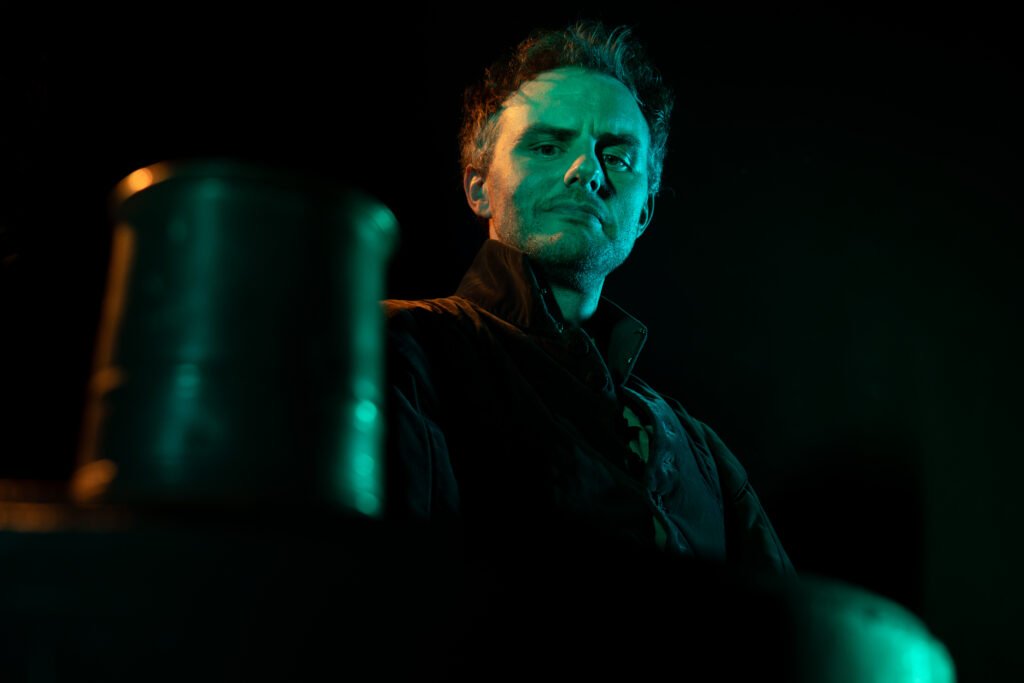
Danny Solomon as RobertSouthwell (Photo: Kai Dorovko)
There has long been debate on where Shakespeare’s religious allegiance lay. One of the explanations for his absence has been that he was living with a Catholic family. While he was mostly writing for Elizabeth I who is famously quoted as saying, ” I have no desire to make windows into men’s souls,” the change of state religion under her father Henry VIII and back again under Mary Tudor and reversing again under herself had led to instability and fear of popery. The 1588 attempted invasion of the many small and not so small boats that were the Spanish Armada cannot have helped the fear of the threat of Catholicism. Interesting isn’t it that today some of the antipathy towards the small boat invasion again has a religious element threatening British freedoms?
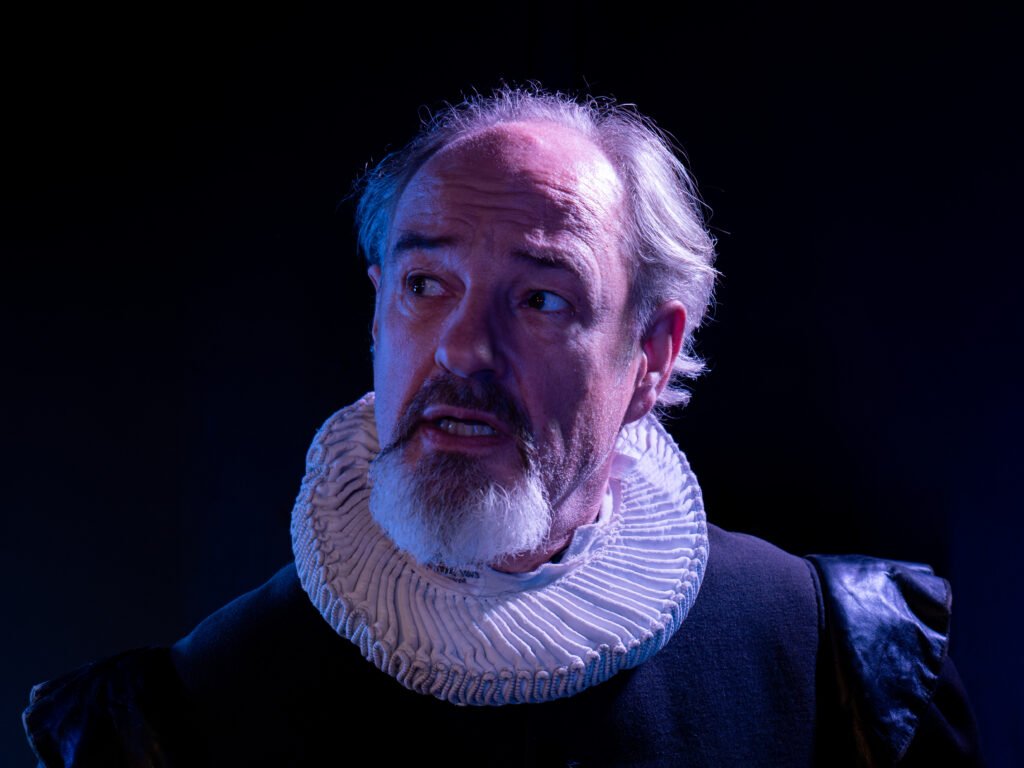
Rovin Kingsland as Sir Richard Topcliffe (Photo: Kai Dorovko)
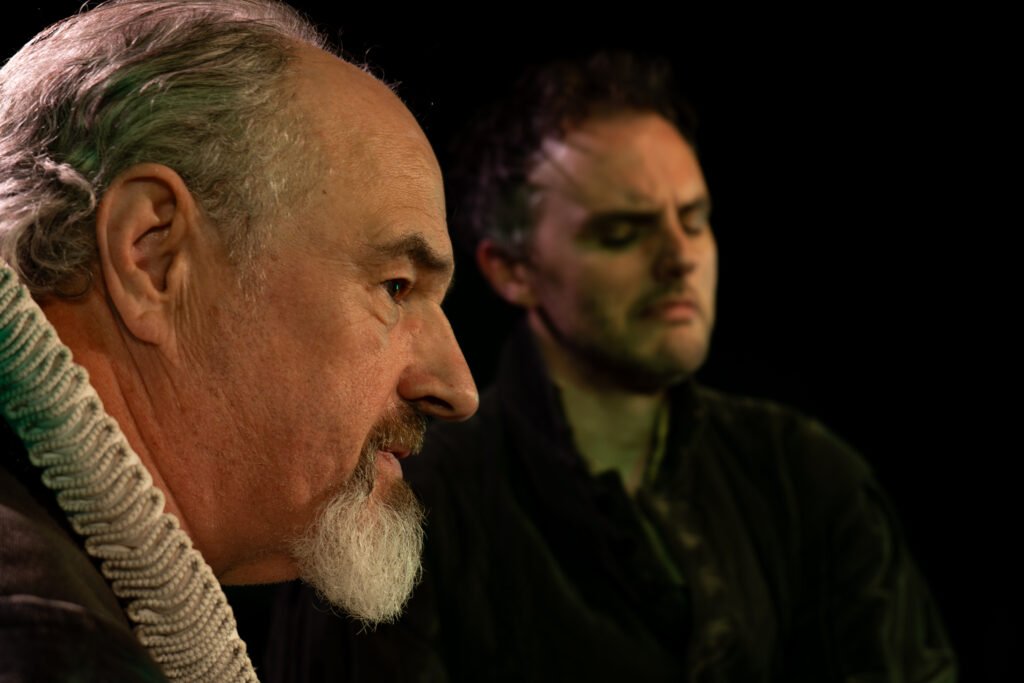
In Jonathan Moore’s play, Shakespeare’s Cousin we meet the poet and Jesuit priest Robert Southwell (Danny Solomon) whilst he is being interrogated to reveal the hiding places of other Catholic priests. Southwell’s interrogator is Sir Richard Topcliffe (Robin Kingsland) who will use torture to extract information from Southwell. Southwell replies with the 17th century Catholic equivalent of “No Comment”, “Ad Majorem Dei Gloriam”, the motto of the Society of Jesus, “For the Greater Glory of God”. Southwell is reputed to be a distant cousin of William Shakespeare because of the dedication of Southwell’s St. Peter’s Complaint, “The Author to His Loving Cousin,” which in some later manuscripts reads rather “To My Worthy Good Cousin Master W.S.”
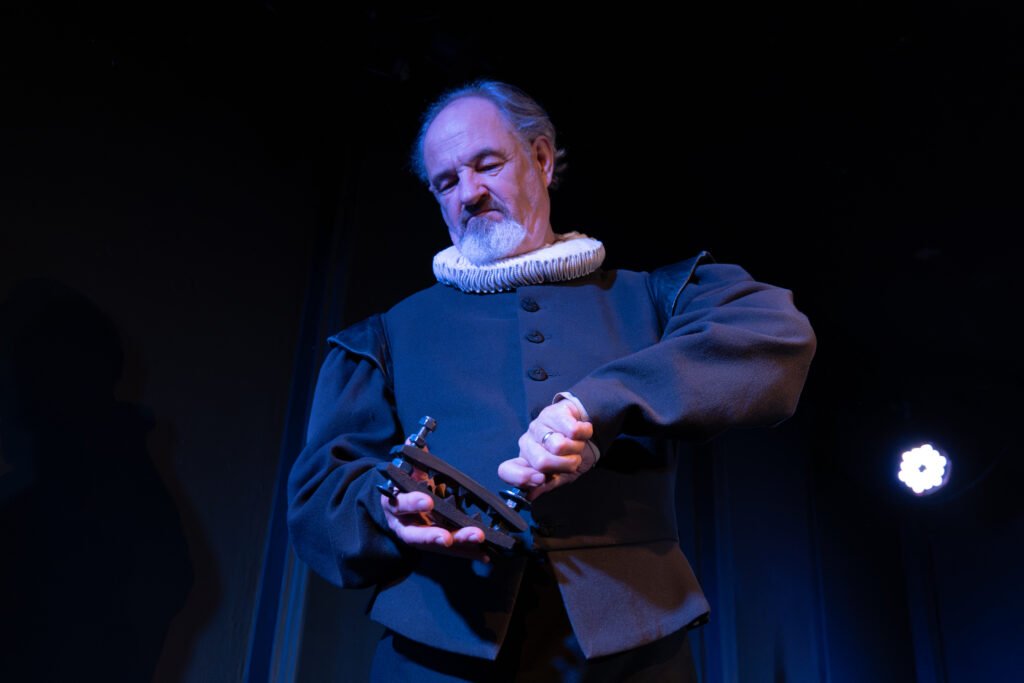
The First Act of Moore’s play is the conversation between Topcliffe and his prisoner Southwell, some of it about poetry and much of it about religious conviction. It is Robin Kingsland whose part is largely monologue as he tries to get Southwell to incriminate Priest sheltering families mentioning, Nicholas Owen, a Catholic architect who was adept at concealing priest holes in large country houses. Southwell himself has been in hiding for six years. There is mention of torture instruments, thumbscrews and Skeffington’s Daughter an iron A frame construction designed to compress the body so it bleeds from the nose and ears. We see Southwell suspended from his wrists.
Robin Kingsland as Sir Richard Topcliffe with his thumbscrews (Photo: Kai Durovko)
In the Second Act a visitor Sir Oliver (Alex Townson) is admitted to persuade Robert Southwell to co-operate. It turns out that Sir Oliver is an actor who is there to support the captive rather than get him to betray his fellow Jesuits. We know what Robert Southwell’s ultimate fate was because he was hanged at Tyburn in 1595 and later canonised by the Catholic Church as Saint Robert Southwell. Ironically the Southwell family money came from monastic lands in Norfolk acquired during the dissolution of the monasteries under Henry VIII.
There is discussion in the play on how the Anglican Church does not believe in Purgatory, the time served by Sinners after Death before being allowed to ascend to Heaven. This reminds as to why many feel Shakespeare was of a Catholic persuasion when Hamlet’s Ghost describes his time in Purgatory. Jonathan Moore’s play tackles a society divided by religion with some contrived parallels to today. The performances are good but the subject matter is dense and brutal.