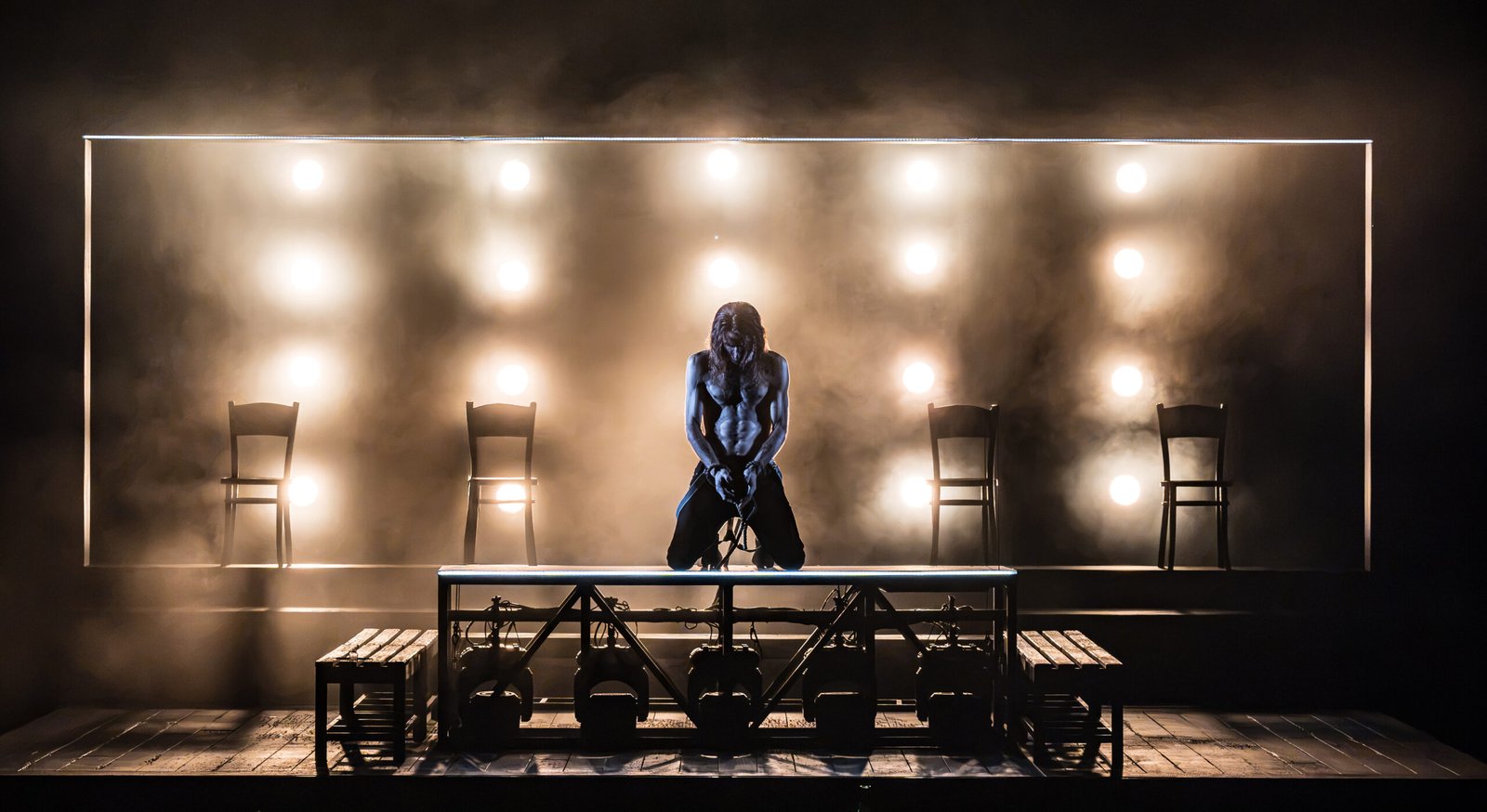
“It is a far, far better thing that I do, than I have ever done; it is a far, far better rest I go to than I have ever known.”
Sydney Carton
Cast in A Tale of Two Cities (Photo: Marc Brenner)
This brilliantly atmospheric production of A Tale of Two Cities, which launches at the Marlowe Theatre Canterbury, has the most remarkable theatre history. The version which has been revised by the Marlowe Theatre was written in 1935 by Terence Rattigan and John Gielgud adapting Dicken’s only novel set in the Eighteenth century for the stage. If you don’t want to read the history go straight to Paragraph Four.
The play was planned by the Albery family of theatre producers to be at Drury Lane but a complaint from an actor derailed it. Faye Compton was to play Lucie Manette and Martita Hunt, Miss Pross. Sir John Martin-Harvey, a veteran actor manager then in his seventies, who had been playing Sydney Carton since 1899 in an adaptation called The Only Way, wrote to Gielgud saying for him to “usurp” Carton would be like playing Henry Irving’s signature role in The Bells while Irving was still alive. A critic, James Agate warned Albery and Gielgud that the proposal would be like “taking bread out of an old man’s mouth”. Not that Mancunian critic’s finest hour.
François Testory as Dr Manette (Photo: Marc Brenner)
Thankfully Rattigan continued to write and sent his comedy French Chalk or Gone Away to Albery and renamed French Without Tears, it became a hit and ran for 1,000 performances starring Rex Harrison, Trevor Howard and Jessica Tandy. Gielgud proposed to Sir Bronson Albery to replace A Tale of Two Cities with a production of Romeo and Juliet starring Peggy Ashcroft as Juliet, Edith Evans as the Nurse and, alternating the roles of Romeo and Mercutio, were Gielgud and Laurence Olivier. The apothecary was played by Alec Guinness.
Robyn Sinclair as Madame Defarge (Photo: Marc Brenner)
The Marlowe have developed this play with the French dialogue being spoken in French with English surtitles which underlines the two cities divided by language. Leo Butler has acted as dramaturg and I note that Audrey Brisson, seen in Amélie the Musical and Piaf has taken part as a Creative Associate.
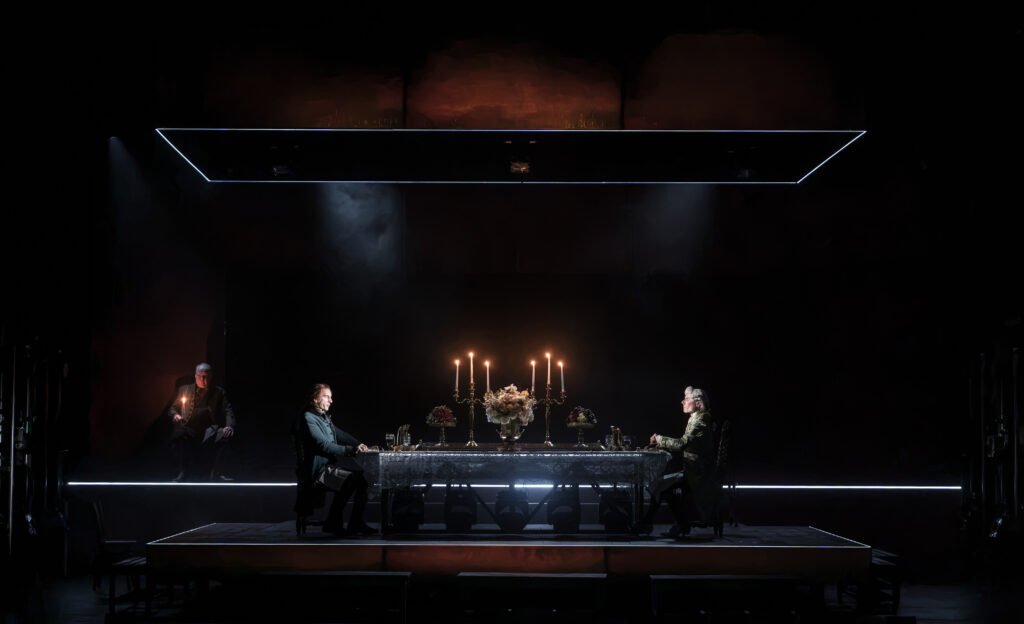
Roger Ringrose as Gabelle, Ed Sayer as the brother of the Marquis de St Evrémonde and Samuel Collings as the Marquis de St Evre2monde (Photo: Marc Brenner)
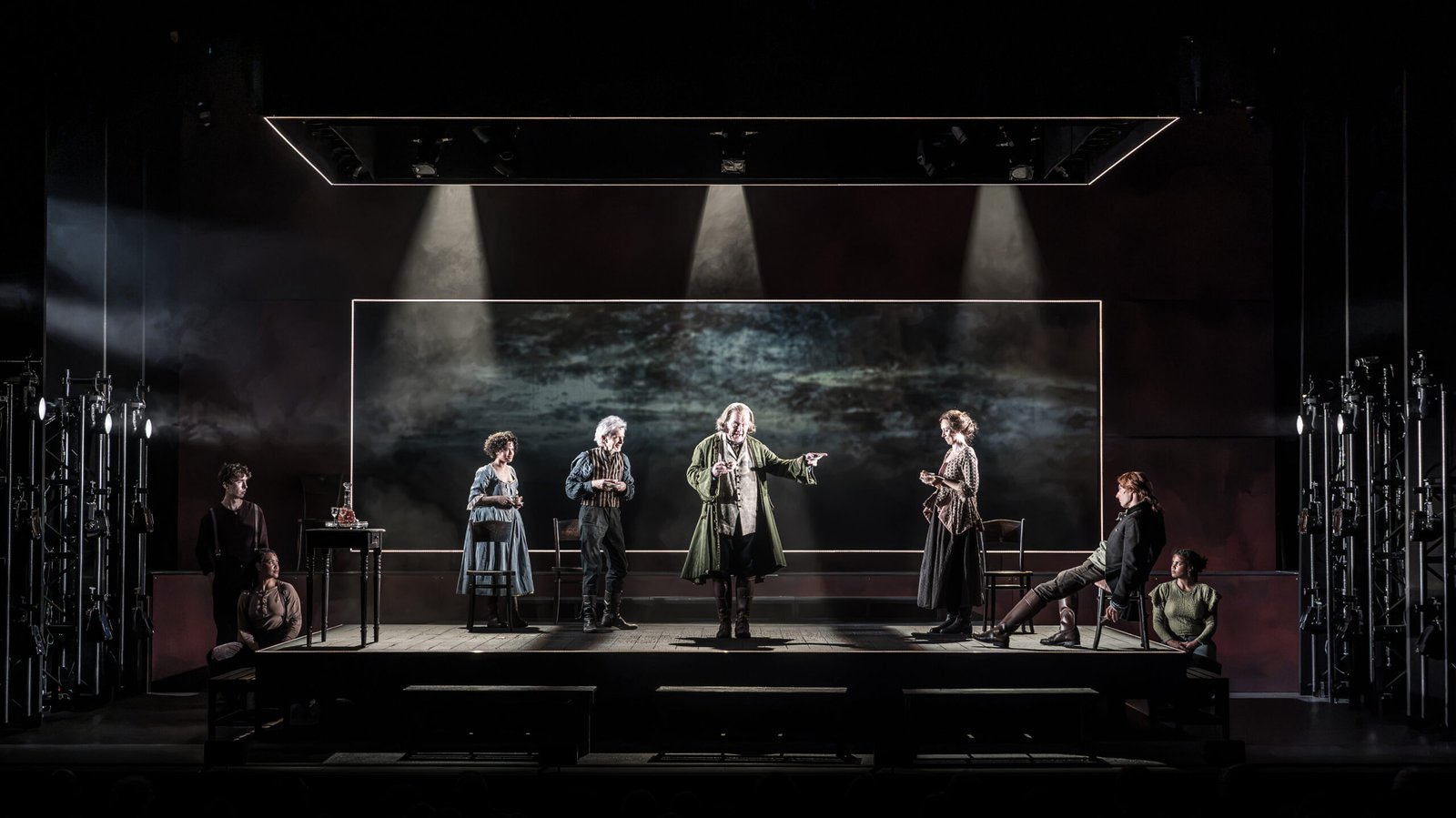
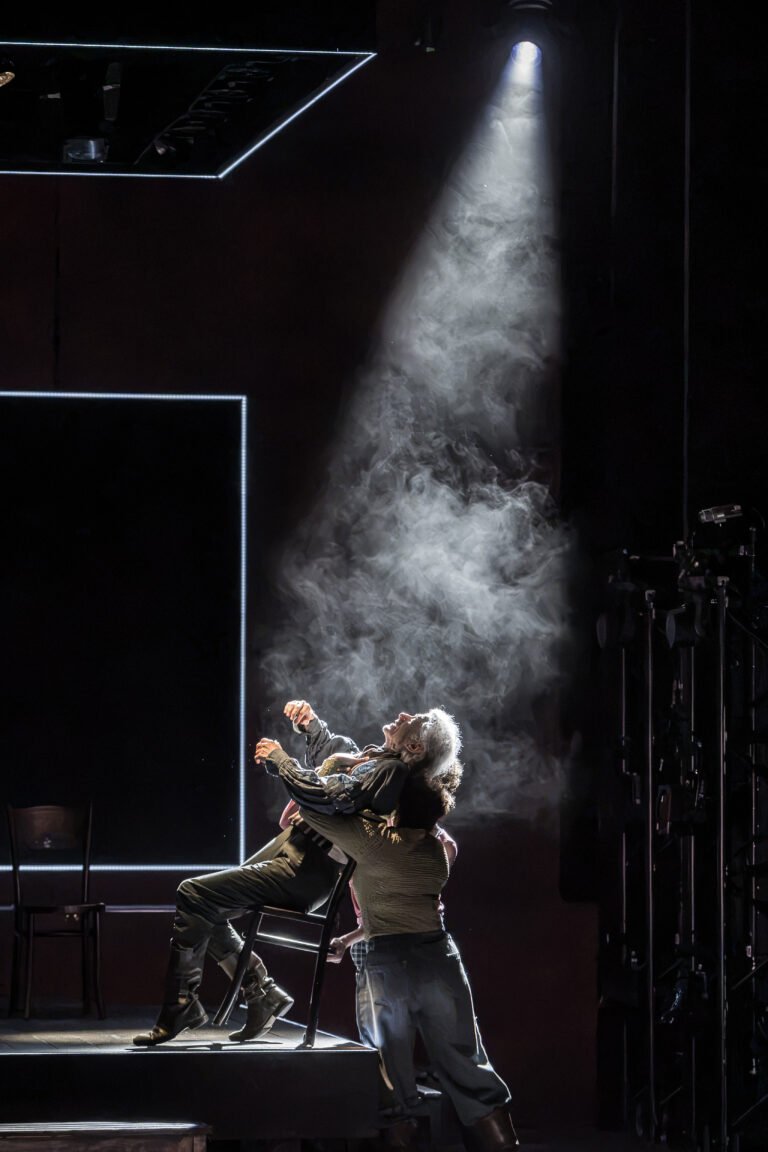
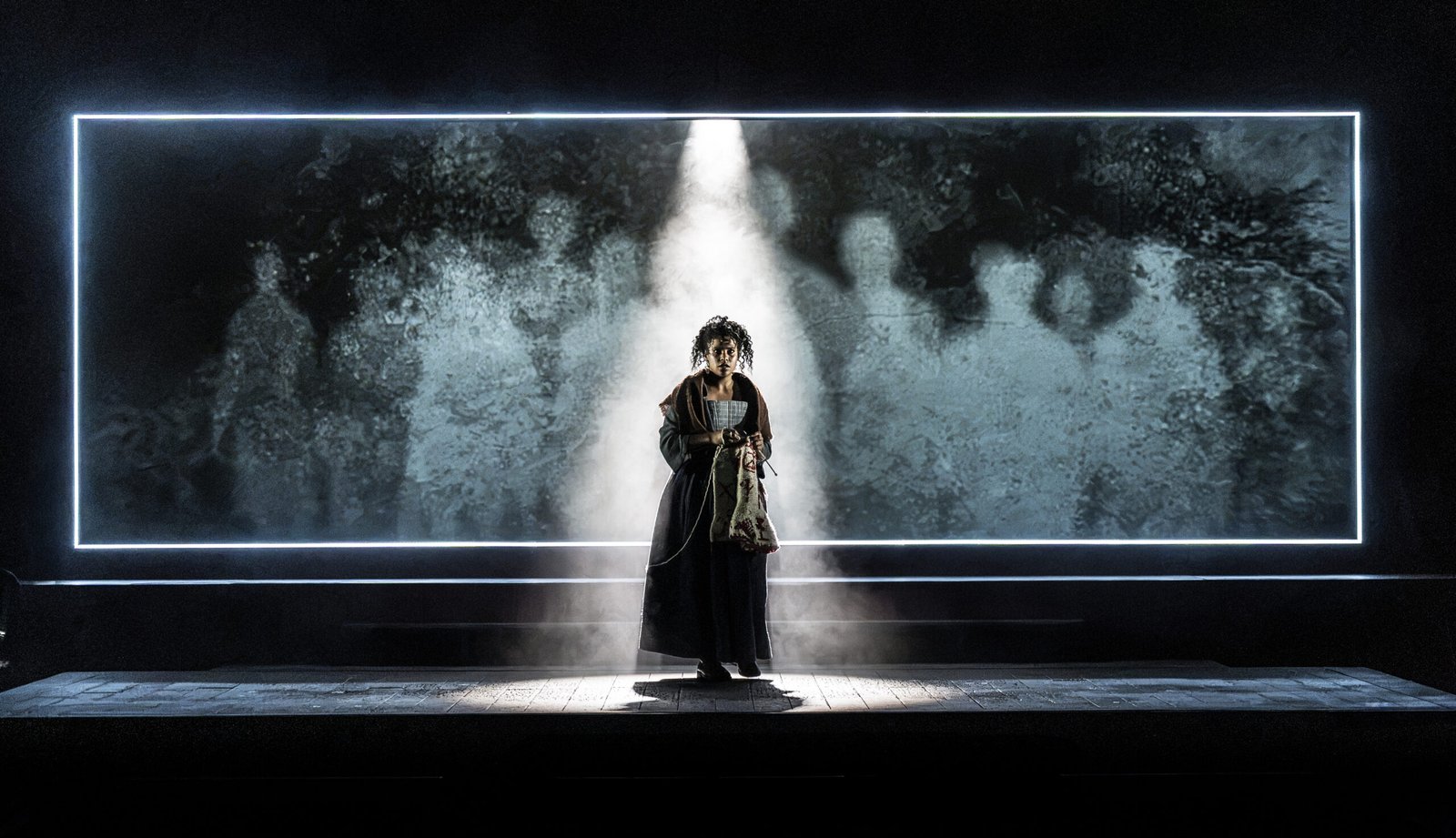
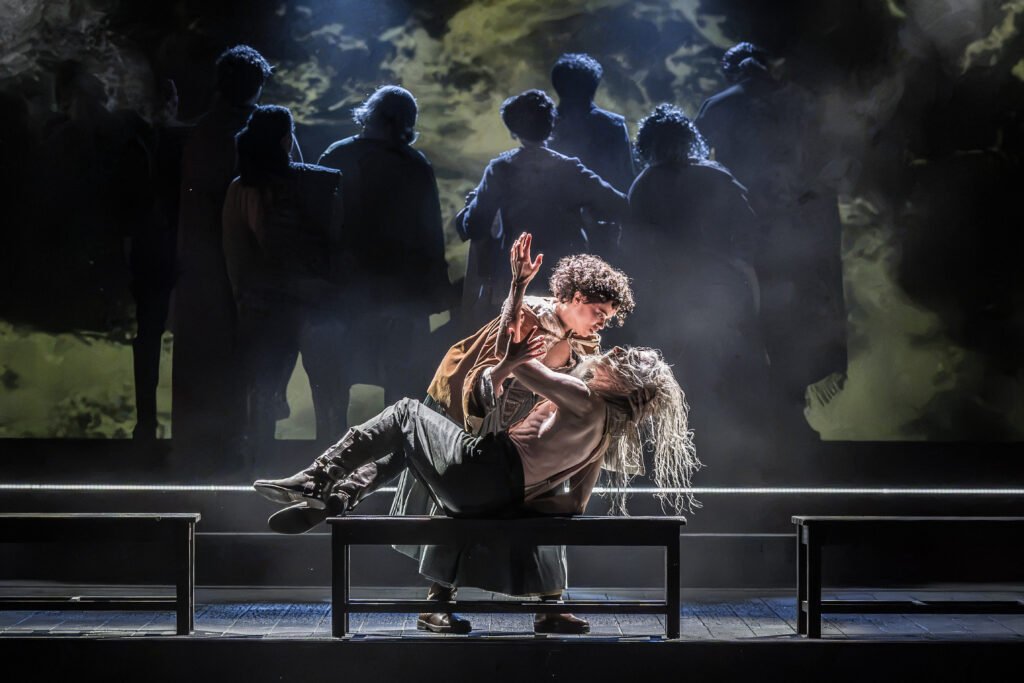
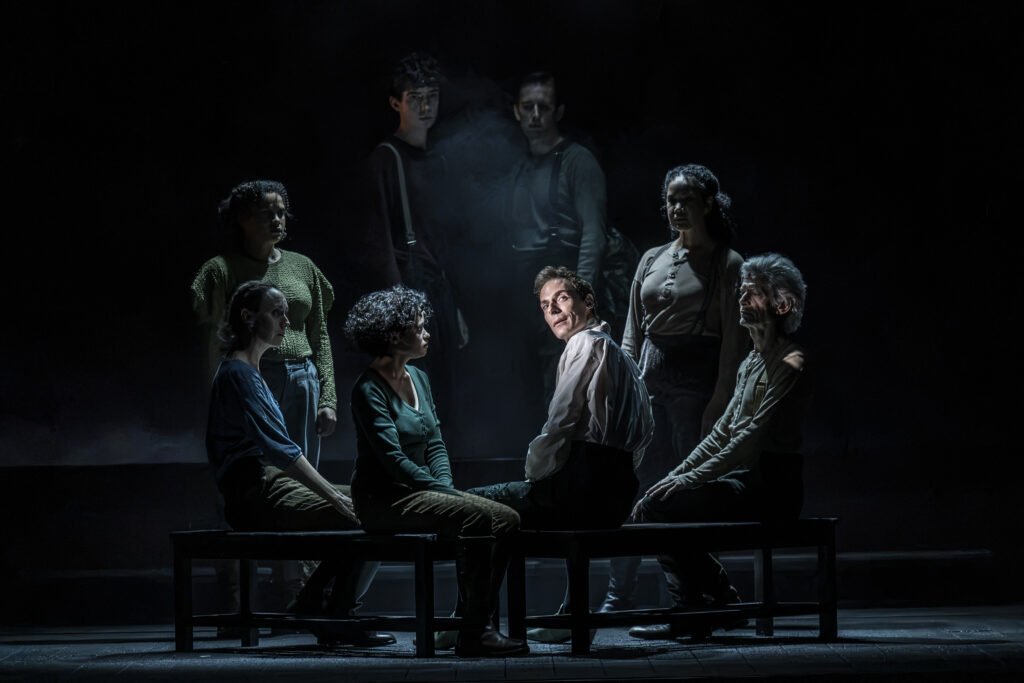
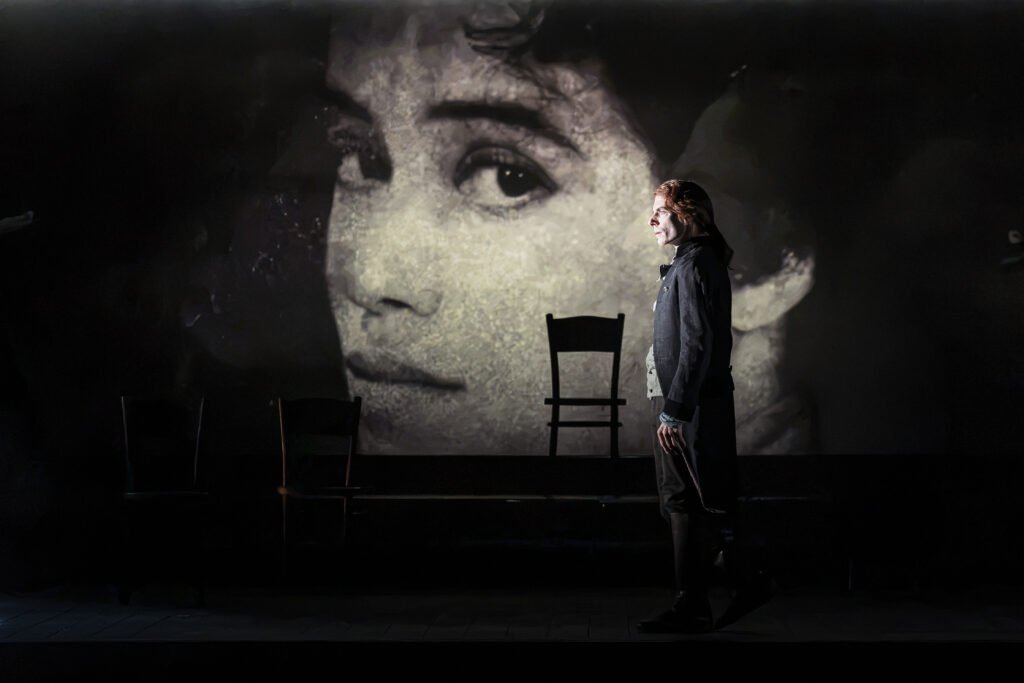
Max Jones’ set is dominated by two lighting slices often with shadowy, impressionistic figures behind in cloud, smoke and shadow. It has to be a flexible space to recreate scenes in prison, in Paris, in London, on board ship and at the guillotine at the Place de la Révolution. Ben Jacobs’ lighting is state of the art and together with Nina Dunn for Pixellux’s video design we are plunged into a dark period of history
Jordan Loughran as Lucie Manette and François Testory as Dr Manette (Photo: Marc Brenner)
This is the iconic start to the novel. “It was the best of times, it was the worst of times, it was the age of wisdom, it was the age of foolishness, it was the epoch of belief, it was the epoch of incredulity, it was the season of Light, it was the season of Darkness, it was the spring of hope, it was the winter of despair, we had everything before us, we had nothing before us, we were all going direct to Heaven, we were all going direct the other way.”
Samuel Collings as Sydney Carton (centre)
(Photo: Marc Brenner)
Briefly the plot is this. In 1775 Dr Alexandre Manette (François Testory) a French physician has been released from 18 years imprisonment in The Bastille. He was imprisoned because he attempted to expose the crimes of rape and murder of the aristocratic Evrémonde family. His daughter Lucie (Jordan Loughran) comes to France with her governess Miss Pross (Scarlett Brookes). Dr Manette is lodging with former servant Defarge (Martin Bassingdale) and his wife Madame Defarge (Robyn Sinclair). The Defarges are later leading revolutionaries.
In Paris the Marquis de St Evrémonde (Samuel Collings) drives his carriage over a child killing it and he is later murdered by the child’s father Gaspard (Simon Startin).
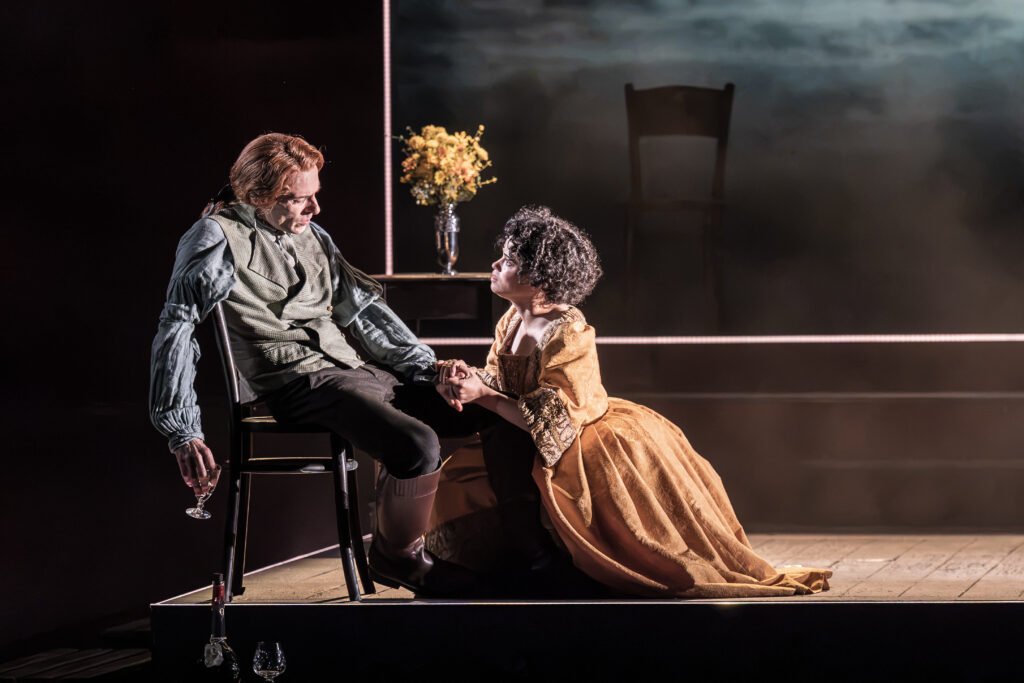
In London in 1780 French émigé Charles Darnay (Ed Sayer) is tried for treason against the British Crown. He is found not guilty on grounds of misidentification when his resemblance to an attending barrister Sydney Carton (Samuel Collings) is noticed. Carton falls for Lucie but she marries Darnay whose original name was St Evrémonde. Dr Manette has cursed anyone bearing the name St Evrémonde. Darnay goes to Paris to help a servant, is arrested and imprisoned. Carton enables a switch with Darnay and so a dissolute, drunken barrister heroically goes to the guillotine in Darnay’s place.
Samuel Collings as Sydney Carton and Jordan Loughran as Lucie Manette
(Photo: Marc Brenner)
Director Michael Fentiman has created a beautifully fluid production with almost ethereal movement. His cast of 11 are usually in two roles, sometimes three but good accents, costumes and wigs ensure definition so we have the impression of a much larger cast. Robyn Sinclair as the knitting guillotine watcher, Madame Defarge gives a sense of danger. If Charles Darnay is the hero, it is the anti-hero, the flawed Sydney Carton we can emotionally identify with. The irony is terrible in that it is the evidence of Dr Manette which brings about such a sentence for his son in law.
Samuel Collings as Carton is the son of the actor David Collings and has obviously inherited the acting gene. We never doubt Carton’s degeneracy and the sense he is disappointed with how his life has turned out but his ending is heroic. Well done to the ensemble cast and the Marlowe for bringing Rattigan and Gielgud’s masterpiece to reality.
Samuel Collings as Sydney Carton
(Photo: Marc Brenner)
There are atmospheric sounds and some music, drums for tension and I also heard the Marseillaise being sung but it is the images which will stay with me the longest. It is no small achievement to give this long novel such an involving staging, the characterisation and acting saving the wordy original novel with clear exposition.
I was blown away by this production and find the run in Canterbury painfully short as I would love to see it again. Details of the UK tour are below. I have no hesitation in awarding it five stars from Theatrevibe the site that doesn’t do stars.
Samuel Collings as Sydney Carton
(Photo: Marc Brenner)
Production Notes
A Tale of Two Cities
Adapted by Terence Rattigan and John Gielgud
Directed by Michael Fentiman
Cast
Starring:
Martin Bassindale
Scarlett Brookes
Samuel Collings
Daniel Hickey
Jasmine Kerr
Jordan Loughran
Roger Ringrose
Ed Sayer
Robyn Sinclair
Simon Startin
François Testory
Creatives
Director: Michael Fentiman
Set Designer: Max Jones
Costume Designer: Kinetic Isidore
Wigs, Hair Makeup Designers: Susanna Peretz
Composer : Barnaby Race
Video Designer: Nina Dunn for Pixellux
Lighting Designer: Ben Jacobs
Sound Designer: Richard Hammarton
Fight director: Jonathan Holby
Dialect Coach : Fabien Enjalric
Information
Running Time: Two hours 20 minutes including an interval