“If you are alive, you are afraid. We are born afraid.”
Dr Hyman
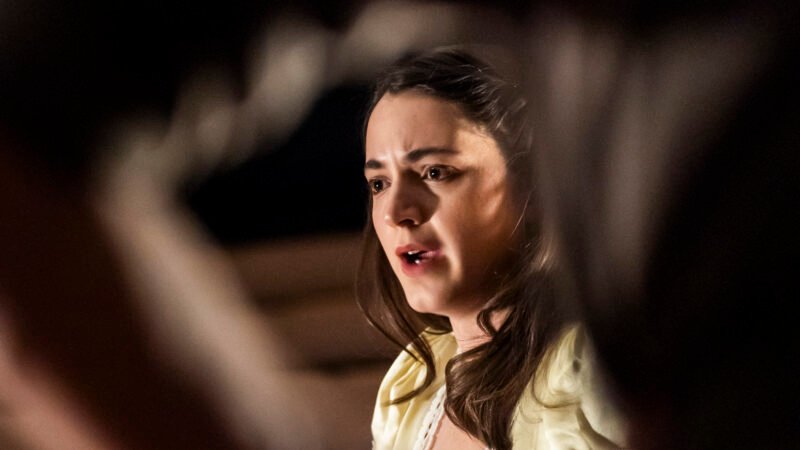
Pearl Chanda as Sylvia Gellberg. (Photo: Tristram Kenton)
Arthur Miller’s late play Broken Glass was first produced in 1994 but is set in 1938 in Brooklyn, New York. Phillip Gellburg (Eli Gelb) finds that his wife Sylvia (Pearl Chanda) has lost the use of her legs and the doctor cannot find a physical cause.
Dr Harry Hyman (Alex Waldmann), like the Gellburgs, Jewish, is consulted. Sylvia Gellburg is profoundly affected by the news coming out of Germany about the terrible persecution of the German Jews and of Kristallnacht or The Night of the Broken Glass, in particular, from which Miller’s play gets its title. Or so it seems.
Sylvia’s hysterical paralysis in reaction to the harrowing tales from Germany may not be so far from home when we learn that Phillip Gellburg is the only Jew working for a Mississippi American Bank in the lending department where his job is to foreclose on mortgages. Gellburg claims to be Finnish, denying his name is really Goldberg and seems to be repressing his Jewishness.
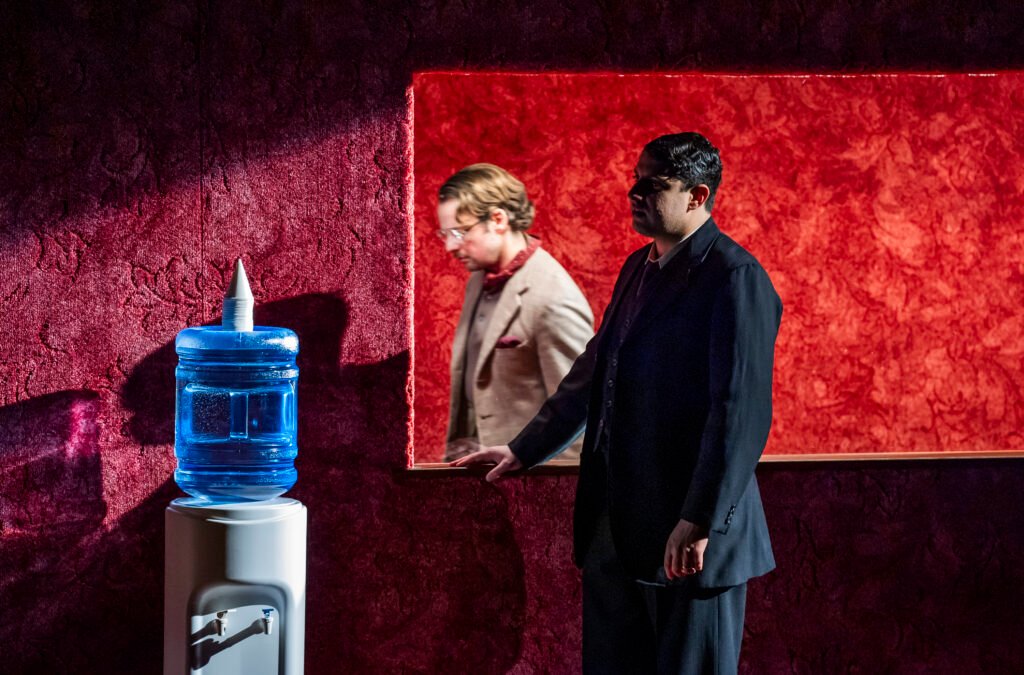
Alex Waldmann as Dr Hyman and Eli Gelb as Phillip Gellburg (Photo: Tristram Kenton)
However, Dr Hyman also uncovers dysfunction in the physical side of the Gellburgs’ marriage which has been going on for twenty years and finds himself attracted to the beautiful Sylvia. Although Dr Hyman is not a psychiatrist, he believes that Sylvia’s paralysis may have a psychological cause. We meet Margaret Hyman (Nancy Carroll) her husband’s secretary/receptionist and wife who informs us of his past fidelities. There is an explicit scene where Margaret and Harry Hyman pleasure each other.
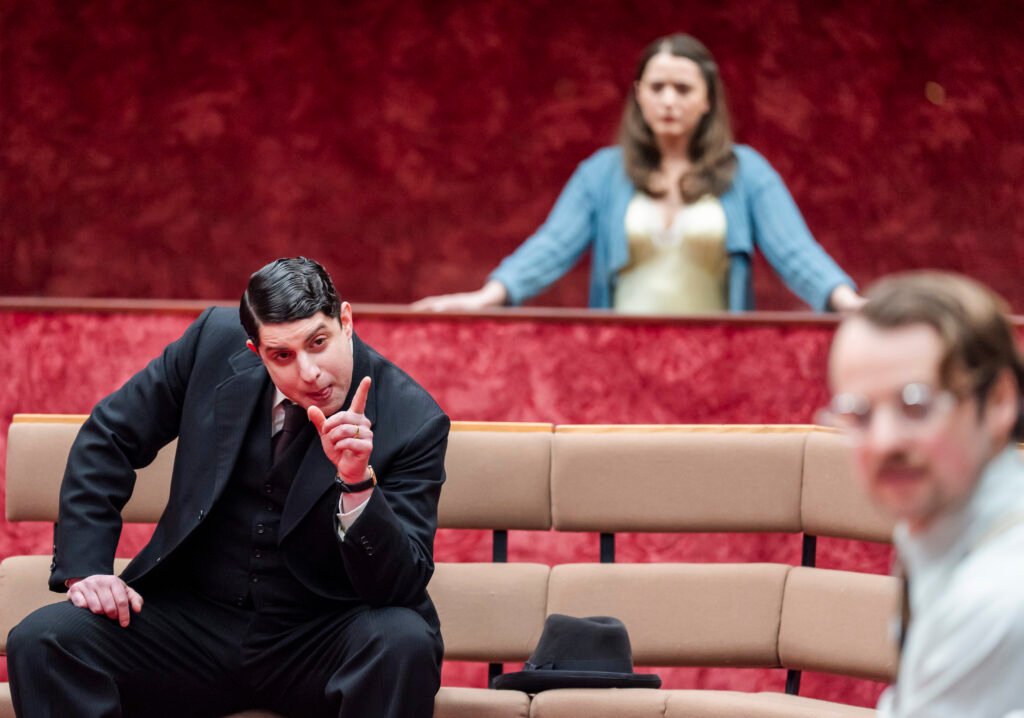
Director Jordan Fein has used a thrust stage which serves as the Gellburg’s bedroom and the doctor’s waiting room. There are no awkward moments changing scene and all the cast sit at the edges next to the many tied up piles of newspaper, a reminder of what has been upsetting Sylvia as she read about Hitler’s Germany. The set has incongruities: a water cooler, the world clocks and a copy of the pink Financial Times. Adam Silverman has used dramatic lighting to emphasise shifts in the play and the discordant Gellburg marriage.
The deeply nasal Brooklyn accents are not easy for those of the British cast. Eli Gelb is the solid, tightly controlled husband in denial about his Jewishness and his erectile dysfunction. He contrasts with Harry Hyman’s intelligent, empathetic, but womanising American doctor whom Sylvia is falling for. She resists any idea to change doctors.
Eli Gelb as Phillip Gellburg , Pearl Chanda as Sylvia Gellburg and Alex Waldmann as Dr HArry Hyman (Photo: Tristram Kenton)
Eli Gelb’s character Phillip is not an endearing one but despite the denials, maybe he is deluding himself. There is a scene where Gellburg opens up and is deeply affecting. Pearl Chanda is a very promising actor – we saw her at the Orange Tree in Tanika Gupta’s Hedda. She spends most of the play alone in the large marital bed, lifting her legs into position because of her inability to move them or support herself.
This is not one of Miller’s best plays but there are still flashes of his great writing in the wit. The ending is sad but not predictable.
Sexist Note:
Hysteria originated in ancient Egypt and Greece, derived from the Greek word hystera which means uterus. Historically, it was believed to be a physical illness caused by the “wandering womb” moving throughout the body, causing suffocation or symptoms like paralysis and emotional outbursts.
Nancy Carroll as Margaret Hyman (Photo: Tristram Kenton)